You cannot learn anything unless you...
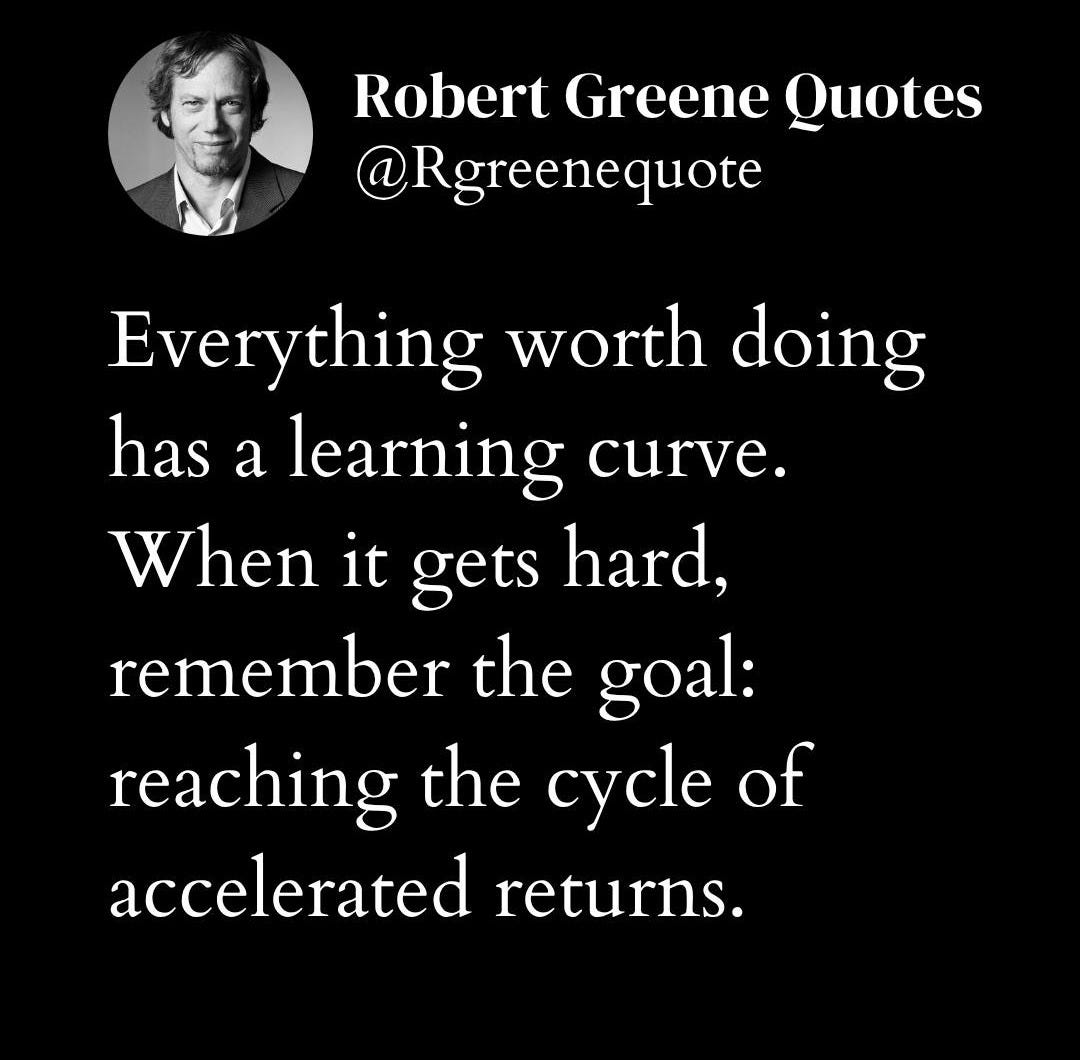
Everything worth doing has a learning curve. When it gets hard, remember the goal: reaching the cycle of accelerated returns.

Most people quit at exactly the wrong moment.
They start learning something a skill, a craft, a business, a language and for the first few weeks there’s energy. Everything feels new. Progress feels visible. Then somewhere around month two or three, that feeling dies. The work gets harder. The gap between where you are and where you want to be becomes more obvious, not less. You feel like you’re getting worse, not better. You wonder if you’re cut out for this at all.
This is not a sign that something is wrong. This is the learning curve. It is supposed to feel exactly like this.
On the other side of that frustration is a completely different experience. Robert Greene calls it the cycle of accelerated returns. The moment a skill starts to become automatic when you stop having to consciously think about every step, something shifts. The work gets easier. And because it gets easier, it gets more interesting. And because it gets more interesting, you practice more. And because you practice more, you get better faster. And because you’re getting better faster, the whole thing becomes more pleasurable. The cycle feeds itself.
Skill generates interest. Interest generates practice. Practice generates more skill. And it keeps going.
The problem is you cannot enter that cycle without going through the hard part first. Every person who ever became genuinely good at something went through the same frustrating, disorienting early phase. The ones who made it through didn’t have more talent than the ones who quit. They had more trust in the process. They had usually done it before with something else a sport, an instrument, a language and buried somewhere in their memory was the sensation of what it felt like when the cycle finally kicked in. That memory is what carried them past the point where everyone else stopped.
The learning curve is not an obstacle between you and the skill. It is the price of admission into a completely different relationship with that skill. You don’t get to skip it. Nobody does. But almost everyone who gets through it looks back and realizes the hard phase lasted far less time than they thought it would when they were inside it.
HOW TO IMPLEMENT
Expect the hard phase, don’t be surprised by it. Most people quit because the difficulty feels like a signal that something is wrong. It isn’t. every person who has ever mastered anything went through the same disorienting, frustrating early period. The hard phase isn’t a warning that you’re not cut out for this. It’s confirmation that you’re in it. The moment you understand that, it loses most of its power over you.
Focus on one skill at a time and go deep before going wide. Robert Greene says this repeatedly in Mastery that trying to learn multiple things simultaneously kills the process. The cycle of accelerated returns only kicks in when one skill starts becoming automatic. That automation takes concentrated repetition, and you cannot get there if your attention is split across three different things at once. Pick the one skill that matters most right now and stay with it until it stops requiring conscious effort.
Track your practice, not your performance. In the early phase of any skill, your performance will be inconsistent and often discouraging. If you measure progress by how good you are on any given day, you will always have a reason to quit. Measure it instead by whether you showed up and put in the hours. The performance catches up on its own but only if the practice is consistent enough to let it.
Embrace feedback instead of protecting your ego. Robert Greene says the apprenticeship phase requires a specific kind of humility, not the performance of humility, but the actual willingness to be told what you’re doing wrong and to use it. The people who move through the learning curve fastest are not the most talented. They are the ones who process feedback without defensiveness and make corrections quickly. Every piece of criticism in the early phase is information you need. Treat it that way.
Remember that the frustration peak and the breakthrough are almost always the same moment. The point where the skill feels most impossible, where you feel most like quitting, is almost never a sign that you’ve hit a ceiling. It’s a sign that your brain is about to make a leap it hasn’t made yet. If you can hold on through that specific feeling ,not forever, just through that moment you will almost always come out the other side into something that feels completely different from what you were experiencing before.
THE TRUTH
The hard phase doesn’t last as long as it feels like it will when you’re inside it. Every person who has come out the other side says the same thing that they can’t believe they almost stopped right there, so close to the point where everything changed.
Most people never find out what they were actually capable of because they confused the price of admission with a sign to leave.
The ones who get through it don’t look back and think they were special. They just didn’t quit on a hard Tuesday when they felt like they were getting nowhere. That’s the whole difference.
A question for you:
Is there something you walked away from a skill, a project, a pursuit that you quit during the hard phase, right before the cycle might have kicked in?